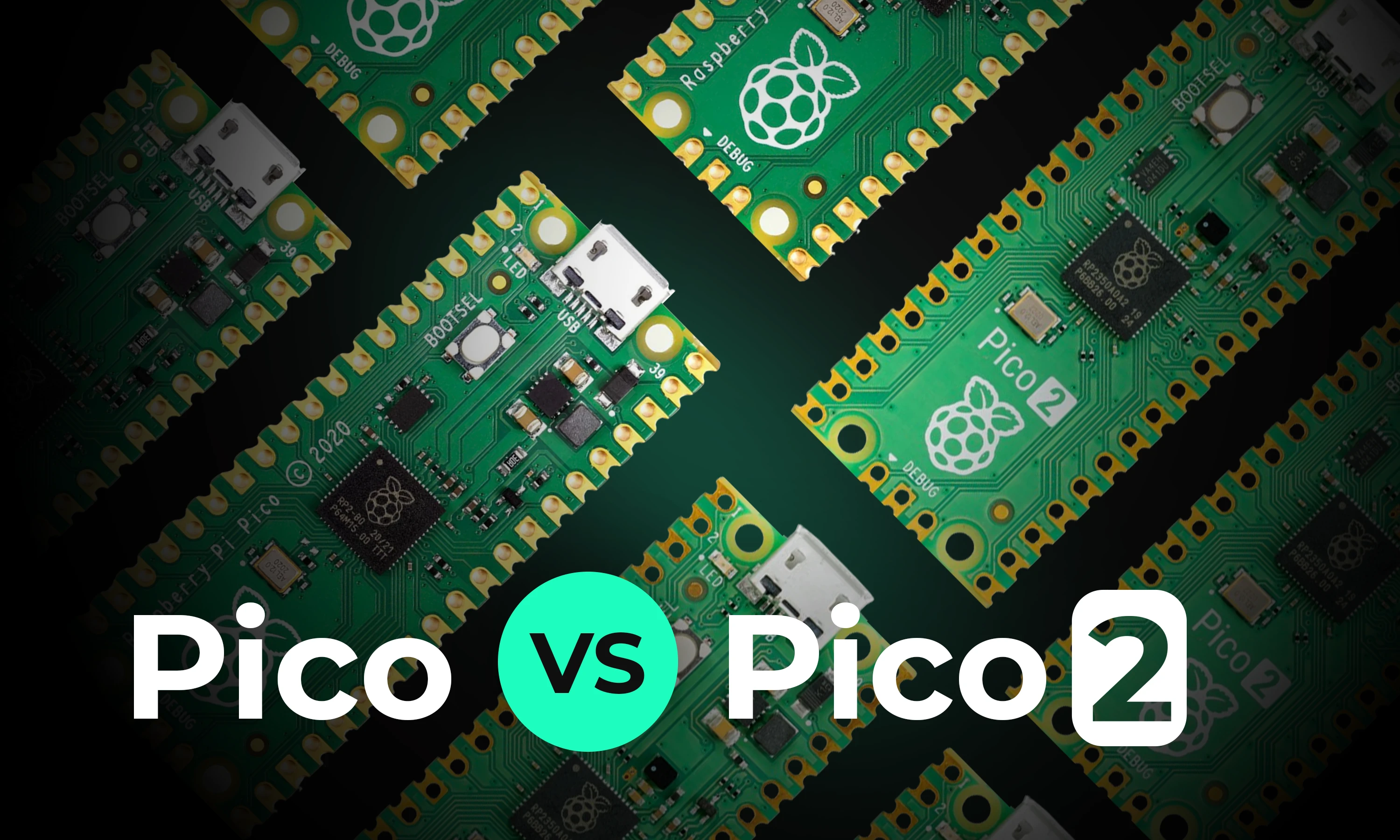
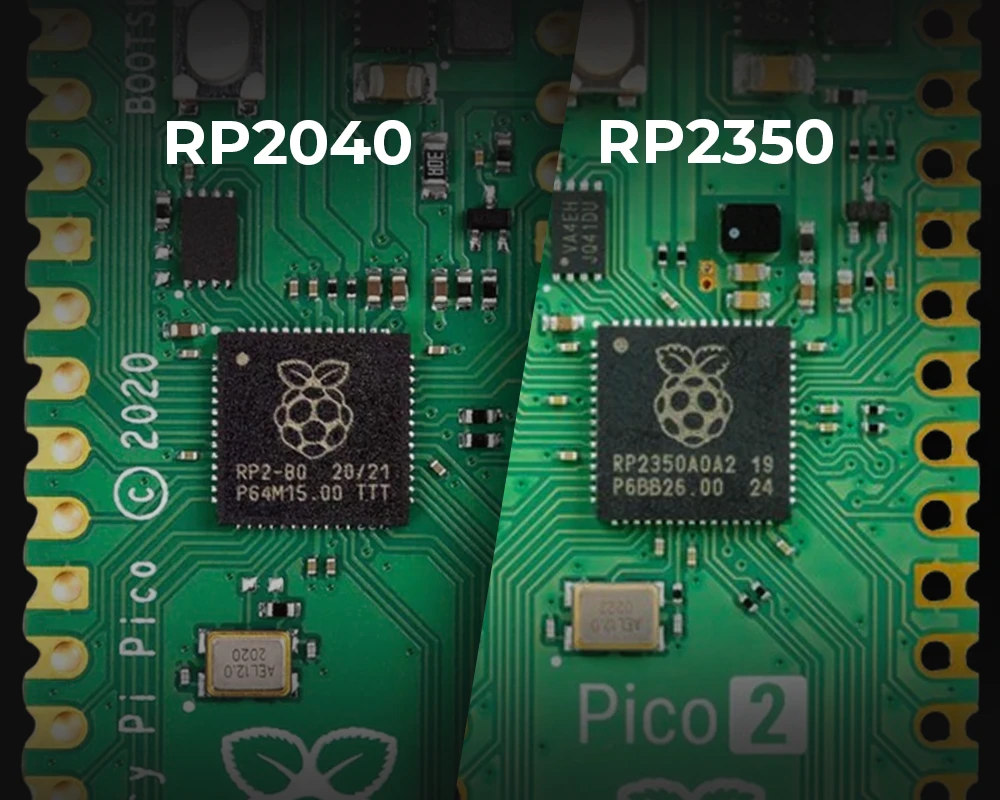
In January 2021, Raspberry Pi Ltd made a significant mark on the microcontroller market with the launch of the Raspberry Pi Pico, a $4 microcontroller board powered by their in-house RP2040 chip. Fast forward to August 2024, and Raspberry Pi has introduced the Raspberry Pi Pico 2, which, despite its similar appearance, brings several noteworthy upgrades, making it a compelling choice for makers and professionals alike.
This article will explore the key differences between the original Raspberry Pi Pico and the new Raspberry Pi Pico 2, focusing on the most significant enhancements and what remains unchanged.
What are the new features of the Raspberry Pi Pico 2?
The Raspberry Pi Pico 2 introduces several new features that set it apart from its predecessor, making it a more powerful and versatile microcontroller:
Enhanced Processing Power
RP2350 SoC: The Pico 2 is powered by the RP2350, which offers a dual-core configuration with either Arm Cortex-M33 cores or the new RISC-V Hazard3 cores. This is a significant upgrade from the RP2040's dual Cortex-M0+ cores, providing more processing power and flexibility. The clock speed has also been increased to 150 MHz from the original 133 MHz.
520KB SRAM: The Pico 2 doubles the SRAM from 264KB to 520KB, allowing for more complex applications and larger datasets.
4MB Flash Storage: The onboard QSPI flash storage has also been doubled from 2MB to 4MB, providing more space for program storage and data handling.
Advanced Security Features
Arm TrustZone and Secure Boot: The RP2350 includes Arm TrustZone technology, which provides a secure execution environment for critical tasks. It also features secure boot capabilities, ensuring that only trusted software can run on the device.
8KB OTP Memory: An 8KB OTP (One-Time Programmable) memory is available for secure key storage, enhancing the security of the Pico 2 for sensitive applications.
Improved Analog and Digital I/O
4 x 12-bit ADC: The number of analog-to-digital converters (ADCs) has increased from 3 to 4, with each ADC offering 12-bit resolution for more precise analog signal processing.
More PWM Channels: The number of PWM channels has been expanded from 16 to 24, providing greater control over devices like motors and LEDs.
More Programmable IO (PIO) State Machines: The number of PIO state machines has increased from 8 to 12, allowing for more custom hardware interfaces and complex I/O operations.
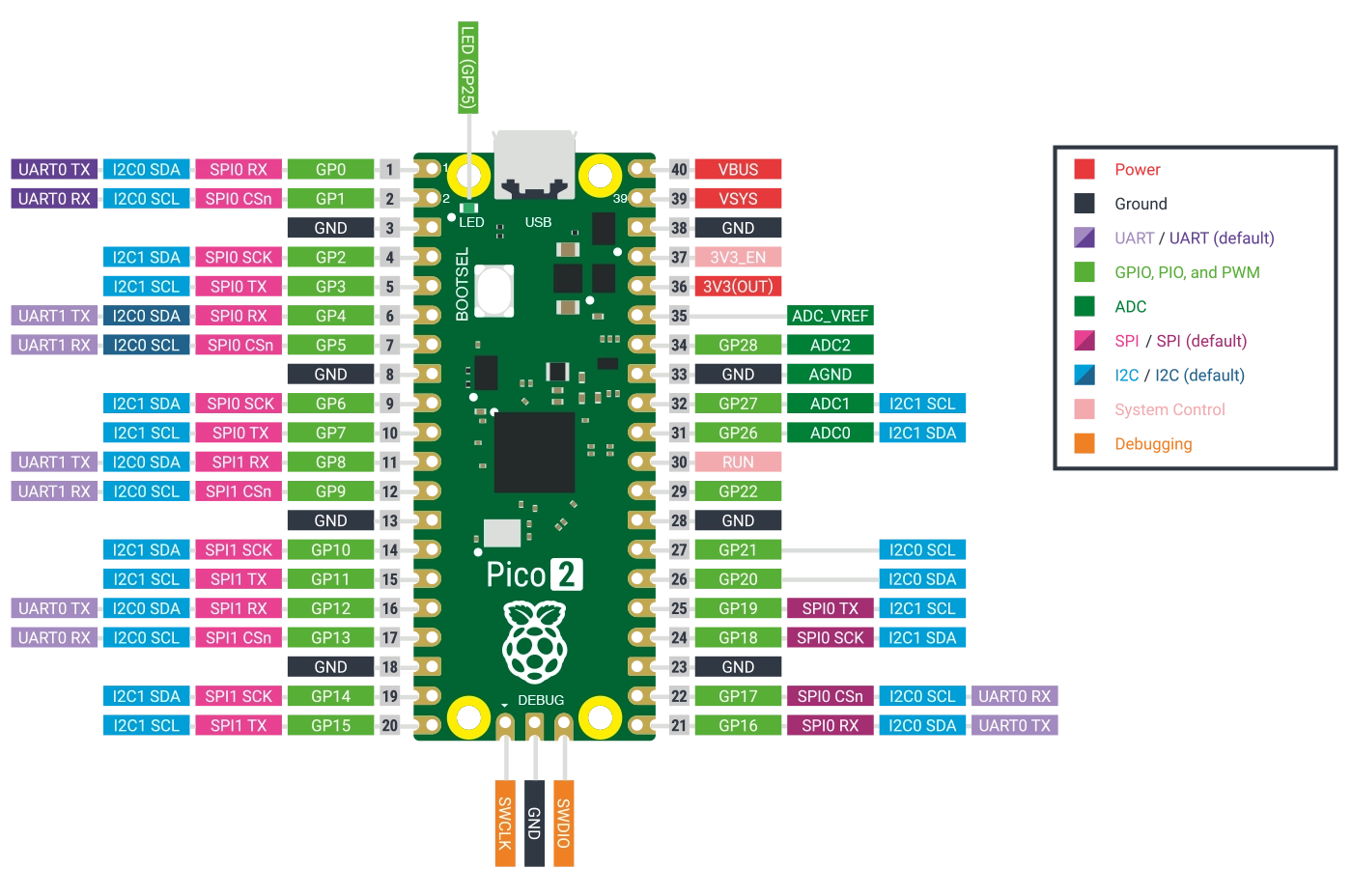
Pinout Diagram of Raspberry Pi Pico
Lower Power Consumption
Improved Sleep Mode Efficiency: The Pico 2 has dramatically reduced power consumption in sleep mode, drawing less than 10uA compared to the original Pico’s 100uA. This improvement makes the Pico 2 ideal for battery-powered and energy-sensitive projects.
Support for RISC-V Architecture
Dual-Core RISC-V Hazard3: The RP2350 is the first Raspberry Pi product to offer a RISC-V-based CPU, specifically the Hazard3 cores. This inclusion is a significant milestone for Raspberry Pi, potentially signaling a broader adoption of RISC-V in future products.
{{insert-project-1-here}}
What are the key differences between Raspberry Pi Pico and Raspberry Pi Pico 2?
Discover how the Raspberry Pi Pico 2 outshines its predecessor, Raspberry Pi Pico.
Microcontroller Specifications Comparison
| Feature | Raspberry Pi Pico 2 | Raspberry Pi Pico |
| :=== | :=== | :== |
| SoC | RP2350, Dual Core Arm Cortex M33 or Dual Core RISC-V Hazard3 running at up to 150 MHz | RP2040, Dual Core Arm Cortex M0+ running at up to 133 MHz |
| SRAM | 520 KB | 264 KB |
| Flash Storage | 4MB QSPI | 2MB QSPI |
| Security | Arm TrustZone, 8KB OTP, Secure Boot | None |
| Wi-Fi / Bluetooth | None | None (Pico W has this) |
| Language Support | MicroPython, CircuitPython, C, C++ | MicroPython, CircuitPython, C, C++ |
Microcontroller (MCU)
Raspberry Pi Pico: The original Pico is powered by the RP2040 microcontroller, featuring a dual-core Arm Cortex-M0+ processor running at up to 133 MHz.
Raspberry Pi Pico 2: The Pico 2 introduces the RP2350 microcontroller, which comes with a choice between two CPU configurations: a dual-core Arm Cortex-M33 or a dual-core RISC-V Hazard3 CPU, running at up to 150 MHz. This is the first time a Raspberry Pi product has been powered by a RISC-V CPU, signaling a potential future direction for the platform. The addition of RISC-V cores provides an open-source architecture, offering developers more flexibility and customization options.
Memory and Storage
Raspberry Pi Pico: Equipped with 264KB of SRAM and 2MB of QSPI flash storage.
Raspberry Pi Pico 2: The Pico 2 significantly upgrades its memory and storage, doubling the SRAM to 520KB and the QSPI flash storage to 4MB. This increase allows for more complex and resource-intensive applications, making the Pico 2 a more powerful microcontroller for various projects.
Security Features
Raspberry Pi Pico: The RP2040 microcontroller does not feature any dedicated security capabilities.
Raspberry Pi Pico 2: The RP2350 introduces advanced security features such as Arm TrustZone, 8KB of OTP (One-Time Programmable) memory for secure key storage, secure boot, SHA-256 acceleration, a hardware True Random Number Generator (TRNG), and fast glitch detectors. These features provide a robust security architecture, making the Pico 2 an excellent choice for secure applications.
I/O and Connectivity Comparison
| Feature | Raspberry Pi Pico 2 | Raspberry Pi Pico |
| :=== | :=== | :== |
| GPIO Pins | 26 x Digital IO | 26 x Digital IO |
| ADC | 4 x 12-bit ADC | 3 x 12-bit ADC |
| UART Interfaces | 2 | 2 |
| I2C Interfaces | 2 | 2 |
| SPI Interfaces | 2 | 2 |
| PWM Channels | 24 | 16 |
| PIO State Machines | 12 | 8 |
| Onboard LED | GPIO 25 | GPIO 25 |
Analog and Digital I/O
Raspberry Pi Pico: The original Pico offers 3 x 12-bit ADCs, 26 digital I/O pins, 2 x UART, 2 x I2C, 2 x SPI, 16 PWM channels, and 8 Programmable I/O (PIO) state machines.
Raspberry Pi Pico 2: The Pico 2 enhances the I/O capabilities by providing 4 x 12-bit ADCs, expanding PWM channels to 24, and increasing the number of PIO state machines to 12. These enhancements offer more precision and flexibility in handling analog signals and controlling peripherals.
Connectivity
Raspberry Pi Pico: The original Pico does not include built-in Wi-Fi or Bluetooth, although the Pico W variant does for $6.
Raspberry Pi Pico 2: Like its predecessor, the Pico 2 lacks built-in wireless connectivity. However, Raspberry Pi has confirmed that a Raspberry Pi Pico W 2, with Wi-Fi and Bluetooth, will be released later this year, aiming to stay under the $10 price point.
{{insert-project-2-here}}
Power and Physical Specifications
| Feature | Raspberry Pi Pico 2 | Raspberry Pi Pico |
| :=== | :=== | :== |
| Power Consumption | less than 10uA in sleep mode | 100uA in sleep mode |
| Power Input | 1.8 to 5.5V via Micro USB or VSYS | 1.8 to 5.5V via Micro USB or VSYS |
| Dimensions | 21 x 51mm | 21 x 51mm |
| Price | $5 | $4 |
Power Consumption
Raspberry Pi Pico: Known for its low power consumption, the RP2040 consumes around 100uA in sleep mode.
Raspberry Pi Pico 2: The Pico 2 improves power efficiency further, reducing sleep mode consumption to less than 10uA, making it ten times more power-efficient than its predecessor. This improvement is particularly advantageous for battery-powered and energy-sensitive applications.
Compatibility and Form Factor
Raspberry Pi Pico: Features a 21 x 51mm form factor with 40 GPIO pins, including castellations for surface mounting.
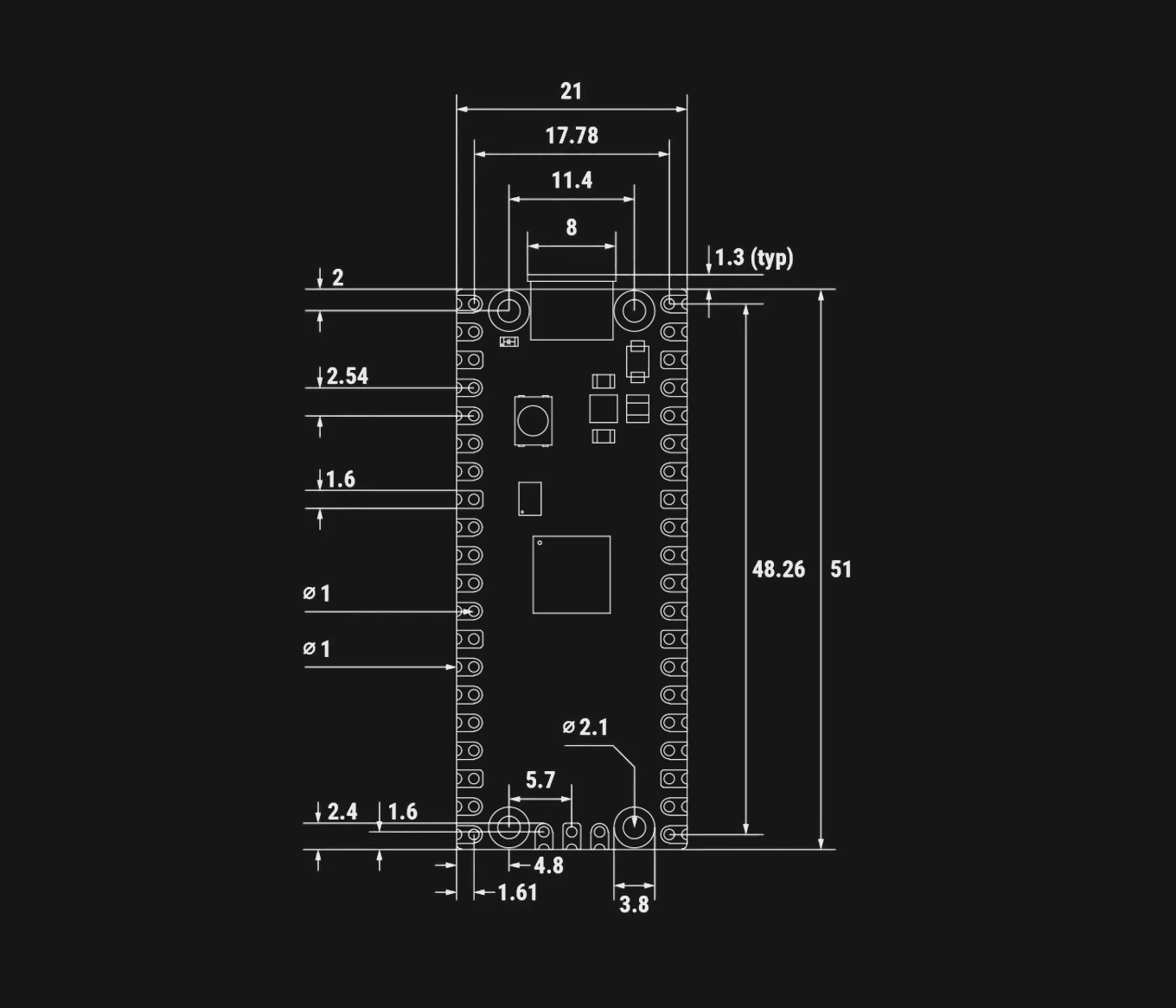
Raspberry Pi Pico 2: The Pico 2 retains the same footprint and GPIO pinout, ensuring compatibility with existing accessories and boards. The continued use of a micro USB connector, rather than USB-C, ensures backward compatibility but might be seen as a drawback by some users.
Technical drawing of the footprint and dimensions of a Raspberry Pi Pico 2 board
Additional Feature Comparison
Raspberry Pi Pico: Includes a precise on-chip clock and timer, a temperature sensor, and optimized floating-point libraries.
Raspberry Pi Pico 2: Introduces enhanced low-power sleep and dormant modes, flexible high-speed user-programmable I/O, and the capability to emulate interfaces like SD Card and VGA.
{{insert-nico-video}}
The Raspberry Pi Pico 2 builds on the foundation laid by the original Pico, offering enhanced processing power, more memory, and advanced security features, all while maintaining the same form factor and price point. The introduction of RISC-V cores in the RP2350 is particularly exciting, signaling a new direction for the Raspberry Pi platform. Whether you're working on a new project or considering an upgrade, the Pico 2 provides a seamless transition with backward compatibility and forward-looking features.
As software support catches up with the new hardware capabilities, especially for the RISC-V cores, the Raspberry Pi Pico 2 is set to become an even more powerful tool in the maker community.
Join the evolution of microcontrollers — sign up for Flux and start innovating with the Raspberry Pi Pico 2 today!
This article will explore the key differences between the original Raspberry Pi Pico and the new Raspberry Pi Pico 2, focusing on the most significant enhancements and what remains unchanged.
What are the new features of the Raspberry Pi Pico 2?
The Raspberry Pi Pico 2 introduces several new features that set it apart from its predecessor, making it a more powerful and versatile microcontroller:
Enhanced Processing Power
RP2350 SoC: The Pico 2 is powered by the RP2350, which offers a dual-core configuration with either Arm Cortex-M33 cores or the new RISC-V Hazard3 cores. This is a significant upgrade from the RP2040's dual Cortex-M0+ cores, providing more processing power and flexibility. The clock speed has also been increased to 150 MHz from the original 133 MHz.
520KB SRAM: The Pico 2 doubles the SRAM from 264KB to 520KB, allowing for more complex applications and larger datasets.
4MB Flash Storage: The onboard QSPI flash storage has also been doubled from 2MB to 4MB, providing more space for program storage and data handling.
Advanced Security Features
Arm TrustZone and Secure Boot: The RP2350 includes Arm TrustZone technology, which provides a secure execution environment for critical tasks. It also features secure boot capabilities, ensuring that only trusted software can run on the device.
8KB OTP Memory: An 8KB OTP (One-Time Programmable) memory is available for secure key storage, enhancing the security of the Pico 2 for sensitive applications.
Improved Analog and Digital I/O
4 x 12-bit ADC: The number of analog-to-digital converters (ADCs) has increased from 3 to 4, with each ADC offering 12-bit resolution for more precise analog signal processing.
More PWM Channels: The number of PWM channels has been expanded from 16 to 24, providing greater control over devices like motors and LEDs.
More Programmable IO (PIO) State Machines: The number of PIO state machines has increased from 8 to 12, allowing for more custom hardware interfaces and complex I/O operations.
Pinout Diagram of Raspberry Pi Pico
Lower Power Consumption
Improved Sleep Mode Efficiency: The Pico 2 has dramatically reduced power consumption in sleep mode, drawing less than 10uA compared to the original Pico’s 100uA. This improvement makes the Pico 2 ideal for battery-powered and energy-sensitive projects.
Support for RISC-V Architecture
Dual-Core RISC-V Hazard3: The RP2350 is the first Raspberry Pi product to offer a RISC-V-based CPU, specifically the Hazard3 cores. This inclusion is a significant milestone for Raspberry Pi, potentially signaling a broader adoption of RISC-V in future products.
{{insert-project-1-here}}
What are the key differences between Raspberry Pi Pico and Raspberry Pi Pico 2?
Discover how the Raspberry Pi Pico 2 outshines its predecessor, Raspberry Pi Pico.
Microcontroller Specifications Comparison
| Feature | Raspberry Pi Pico 2 | Raspberry Pi Pico |
| :=== | :=== | :== |
| SoC | RP2350, Dual Core Arm Cortex M33 or Dual Core RISC-V Hazard3 running at up to 150 MHz | RP2040, Dual Core Arm Cortex M0+ running at up to 133 MHz |
| SRAM | 520 KB | 264 KB |
| Flash Storage | 4MB QSPI | 2MB QSPI |
| Security | Arm TrustZone, 8KB OTP, Secure Boot | None |
| Wi-Fi / Bluetooth | None | None (Pico W has this) |
| Language Support | MicroPython, CircuitPython, C, C++ | MicroPython, CircuitPython, C, C++ |
Microcontroller (MCU)
Raspberry Pi Pico: The original Pico is powered by the RP2040 microcontroller, featuring a dual-core Arm Cortex-M0+ processor running at up to 133 MHz.
Raspberry Pi Pico 2: The Pico 2 introduces the RP2350 microcontroller, which comes with a choice between two CPU configurations: a dual-core Arm Cortex-M33 or a dual-core RISC-V Hazard3 CPU, running at up to 150 MHz. This is the first time a Raspberry Pi product has been powered by a RISC-V CPU, signaling a potential future direction for the platform. The addition of RISC-V cores provides an open-source architecture, offering developers more flexibility and customization options.
Memory and Storage
Raspberry Pi Pico: Equipped with 264KB of SRAM and 2MB of QSPI flash storage.
Raspberry Pi Pico 2: The Pico 2 significantly upgrades its memory and storage, doubling the SRAM to 520KB and the QSPI flash storage to 4MB. This increase allows for more complex and resource-intensive applications, making the Pico 2 a more powerful microcontroller for various projects.
Security Features
Raspberry Pi Pico: The RP2040 microcontroller does not feature any dedicated security capabilities.
Raspberry Pi Pico 2: The RP2350 introduces advanced security features such as Arm TrustZone, 8KB of OTP (One-Time Programmable) memory for secure key storage, secure boot, SHA-256 acceleration, a hardware True Random Number Generator (TRNG), and fast glitch detectors. These features provide a robust security architecture, making the Pico 2 an excellent choice for secure applications.
I/O and Connectivity Comparison
| Feature | Raspberry Pi Pico 2 | Raspberry Pi Pico |
| :=== | :=== | :== |
| GPIO Pins | 26 x Digital IO | 26 x Digital IO |
| ADC | 4 x 12-bit ADC | 3 x 12-bit ADC |
| UART Interfaces | 2 | 2 |
| I2C Interfaces | 2 | 2 |
| SPI Interfaces | 2 | 2 |
| PWM Channels | 24 | 16 |
| PIO State Machines | 12 | 8 |
| Onboard LED | GPIO 25 | GPIO 25 |
Analog and Digital I/O
Raspberry Pi Pico: The original Pico offers 3 x 12-bit ADCs, 26 digital I/O pins, 2 x UART, 2 x I2C, 2 x SPI, 16 PWM channels, and 8 Programmable I/O (PIO) state machines.
Raspberry Pi Pico 2: The Pico 2 enhances the I/O capabilities by providing 4 x 12-bit ADCs, expanding PWM channels to 24, and increasing the number of PIO state machines to 12. These enhancements offer more precision and flexibility in handling analog signals and controlling peripherals.
Connectivity
Raspberry Pi Pico: The original Pico does not include built-in Wi-Fi or Bluetooth, although the Pico W variant does for $6.
Raspberry Pi Pico 2: Like its predecessor, the Pico 2 lacks built-in wireless connectivity. However, Raspberry Pi has confirmed that a Raspberry Pi Pico W 2, with Wi-Fi and Bluetooth, will be released later this year, aiming to stay under the $10 price point.
{{insert-project-2-here}}
Power and Physical Specifications
| Feature | Raspberry Pi Pico 2 | Raspberry Pi Pico |
| :=== | :=== | :== |
| Power Consumption | less than 10uA in sleep mode | 100uA in sleep mode |
| Power Input | 1.8 to 5.5V via Micro USB or VSYS | 1.8 to 5.5V via Micro USB or VSYS |
| Dimensions | 21 x 51mm | 21 x 51mm |
| Price | $5 | $4 |
Power Consumption
Raspberry Pi Pico: Known for its low power consumption, the RP2040 consumes around 100uA in sleep mode.
Raspberry Pi Pico 2: The Pico 2 improves power efficiency further, reducing sleep mode consumption to less than 10uA, making it ten times more power-efficient than its predecessor. This improvement is particularly advantageous for battery-powered and energy-sensitive applications.
Compatibility and Form Factor
Raspberry Pi Pico: Features a 21 x 51mm form factor with 40 GPIO pins, including castellations for surface mounting.
Raspberry Pi Pico 2: The Pico 2 retains the same footprint and GPIO pinout, ensuring compatibility with existing accessories and boards. The continued use of a micro USB connector, rather than USB-C, ensures backward compatibility but might be seen as a drawback by some users.
Technical drawing of the footprint and dimensions of a Raspberry Pi Pico 2 board
Additional Feature Comparison
Raspberry Pi Pico: Includes a precise on-chip clock and timer, a temperature sensor, and optimized floating-point libraries.
Raspberry Pi Pico 2: Introduces enhanced low-power sleep and dormant modes, flexible high-speed user-programmable I/O, and the capability to emulate interfaces like SD Card and VGA.
{{insert-nico-video}}
The Raspberry Pi Pico 2 builds on the foundation laid by the original Pico, offering enhanced processing power, more memory, and advanced security features, all while maintaining the same form factor and price point. The introduction of RISC-V cores in the RP2350 is particularly exciting, signaling a new direction for the Raspberry Pi platform. Whether you're working on a new project or considering an upgrade, the Pico 2 provides a seamless transition with backward compatibility and forward-looking features.
As software support catches up with the new hardware capabilities, especially for the RISC-V cores, the Raspberry Pi Pico 2 is set to become an even more powerful tool in the maker community.
Join the evolution of microcontrollers — sign up for Flux and start innovating with the Raspberry Pi Pico 2 today!
Share
Jharwin Barrozo
Jharwin is an electronics engineer mainly focused on satellites. He built his own ground station using Flux to monitor RF activities on the International Space Station. Find him on Flux @jharwinbarrozo
Go 10x faster from idea to PCB
Work with Flux like an engineering intern—automating the grunt work, learning your standards, explaining its decisions, and checking in for feedback at key moments.
Discover our latest schematic design updates that streamline wire adjustments, component alignment, and intuitive pin connections, making your design process faster and meeting your high standards for precision. These enhancements, coupled with our AI design assistant, ensure a solid foundation for your projects.
Despite newer technologies like USB and Ethernet, RS232 remains widely used due to its simplicity and broad compatibility. It's crucial in industries, scientific instruments, networking gear, and legacy computers. This protocol's reliability makes it the go-to for many applications. In this blog, we'll explore why RS232 continues to be relevant in our tech-savvy world.
The blog post provides an in-depth look at the LM741 pinout diagram, explaining the functions of each pin, including inverting and non-inverting inputs, and comparing the LM741 to the LM324. It also covers various applications of the LM741 as an amplifier and a comparator.
The Raspberry Pi Zero 2 W is a small and powerful computer with impressive performance for its size and price. With a quad-core processor, 512MB of RAM, built-in wireless connectivity, and a USB On-The-Go port, it's suitable for many projects, including home automation, media centers, and robotics.
If you're looking to improve your understanding of schematic diagrams, this article is the perfect starting point. Let's explore the crucial role of circuits and components schematics in translating conceptual electrical designs into physical printed circuit board assemblies (PCBAs).
We’re excited to announce our partnership with Ultra Librarian to bring millions of high quality and trustworthy components directly to the Flux ecosystem. This partnership marks a big step towards bringing together all semiconductor manufacturers, distributors, engineers, and the whole hardware industry.
Hardware raises the stakes, iteration is slower and costlier, so you can’t stumble on business basics or customer insight. Winning teams de-risk the business model and iterate fast. This bookshelf helps sharpen judgment and give technical founders the tools to build companies people love.
This article provides a comprehensive guide on pull-up and pull-down resistors, emphasizing their importance in establishing a known voltage level on microcontroller pins. It explains how to implement these resistors in Arduino circuits, discussing functions like pinMode and digitalRead. It also dives into real-world applications, voltage dividers, and tips for avoiding common mistakes.
Think you're familiar with the push button and its symbol? Prepare to be surprised! Join us in our latest blog post where we unravel the intricate science behind every press, click, and circuit, revealing the complexities hidden in the simplicity of a push button switch.
Our 2023 guide compares ESP32 and Arduino, two essential microcontrollers in IoT. ESP32 offers advanced features like Wi-Fi, while Arduino excels in ease of use and community support. Choose based on your project's complexity and needs.
A comprehensive guide to using solder flux in electronics soldering. Soldering flux is used to clean and prepare the surfaces of the components that need to be joined. It helps to remove oxidation and other contaminants that can prevent a strong bond from forming. Flux also reduces surface tension, allowing the solder to flow more easily and improves the wetting of the components.